 |
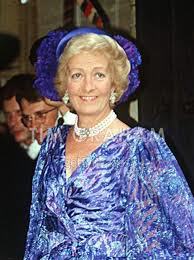
| Princess Diana's Mother, 1989 |
Well, you know, there is a lot of unhappiness in middle age although, to be frank, in the west these are what might be called First World Problems: oh wah, it's harder to stay thin, one is not as attractive as one was at 27, one does not have so much potential, one is less likely than ever to become a millionaire, one's spouse has not given up that annoying habit after umpteen years, one's dear same-age friend has been diagnosed with cancer, one's knees ache half an hour into a dance (if one even goes to a dance), one sometimes feels a shooting pain in one's hand--is it early on-set arthritis?!
Frankly I feel very lucky to have met B.A. a few scant years before I turned forty because he is the right sort of person I need to have around when I am mooching about feeling middle-aged. First World Problem Story: I took out two beautiful young things for dinner and a concert as a sort of chaperone, and--no word of a lie--on my way to the power-room I glanced in a mirror and was instantly reminded of Princess Diana's mother. When, after an evening of accompanying blooming youth, I found B.A. asleep in bed, and I was enormously comforted because he looked as old as I did.
But to go back to dating at 50, good heavens. Surely at 50 it is really time to stop thinking in terms of dating and more in terms of making friends--or keeping--friends? Not only is one too old to have children (or more children), which is what sex is primarily for, SORRY, but one is too old to adopt babies. (Many countries won't let you adopt babies after you turn 40.) If at 50 one decides to marry a friend, old or new, then that's lovely. But surely one of the joys of being in late middle-age is that it really doesn't matter as much?
My grandmother Gladys was widowed at 60, and although terrifically popular with elderly men, she never showed the slightest interest in romance, dating or marriage. She went on holiday with her old pals, she carried on volunteering with her pals (they had a band), she went to seniors events, playing cards and doing aerobics and whatnot, she listened to the radio, she smoked until double-pneumonia told her to stop, she read bodice-rippers and "sagas" late into the night and on Sundays she visited family, i.e. us.
The author of the Telegraph article says that it seems to her better to have been married with children and then divorced than to be single-never-married at 50, but then I suspect she is horrified by the very idea that her children might not have existed. There are many 50-something nuns who are quite content to go on being nuns, and I imagine (indeed, I hope) there are many 50-something women who have passed through their sorrow at never having married and had children and realized that not only are they at peace with it, they wouldn't have it differently now. (I'm still going through BA-and-I-can't-have-children grief myself.)
What is cheerful about her article is that she points out the personal freedom Single women have. The Single woman who is financially independent of a husband or family does get to make all the decisions. She doesn't have to ask permission to go on this trip or that trip or to take early retirement to go back to university or to sell all that she has and give it to the poor.
One thing that interested me most in the article was the cheeky questions the author gets as a "Single" woman over 50. I think she is too optimistic when she says no-one asks young blondes about their sex life, as everyone just assumes they have one. Maybe they didn't when she was a young blonde, but I can assure her that older married people (like male bosses) started asking me such questions when I was 17
As for remarks about married life, I agree that in general in the UK married women are considered sacrosanct and you just do not ask them such questions. An American once did make a salty remark about my marriage at a dinner party, and I hit him with my handbag, right there and then. Were I a widow, I imagine I would level a cold stare at the impertinent person through the top halves of my bifocals (which I am beginning to need) and say that I am devoted to the memory of my late husband. It seems to me that dozens of generations of over-50 British women had something to teach us about dignity.
Update: Someone who married older that I did written in to suggest I am too dismissive of later marriage. I apologize for that. Although the subject of being a Searching Single after the menopause is indeed very important, it is something of which I have no firsthand experience. The best I can say is that I think it must be much different to be a widow, looking back fondly (or not) on one's married days, than to be a Single-never-married. However, I hold out the hope that being Single might matter less, not more, the older we get.


